1985-1998 [Subscribe to Daily Digest] |
 | [Main 9000 Bulletin Board | BBFAQ |
Prev by Date | Next by Date | Post Followup ]
Member Login / Signup - Members see fewer ads. - Latest Member Gallery Photos
Bushing Posted by Ari [Email]  (#2847) [Profile/Gallery]
(more from Ari) on Thu, 26 Oct 2006 06:15:21 (#2847) [Profile/Gallery]
(more from Ari) on Thu, 26 Oct 2006 06:15:21

In Reply to: Re: Some questions, Ron, Wed, 25 Oct 2006 18:09:18 Members see ZERO ads on the bulletin boards and get more feature. - Help Keep This Site Online - Signup |
I haven't found any decent pictures on the web, and it would be a couple of days before I could take a picture of mine and post it somewhere. So instead we'll try with descriptive prose.
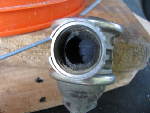
Looking at the 'dogbone' bushing, start at the very center. There is an aluminum tube. Moving outward, that tube has a rubber coating. That coating has two 'arms' of rubber that connect to a larger diameter rubber cylinder, lastly that rubber cylinder is bonded to an aluminum outer cylinder. So between the inner and outer portions, there are two big arcs of open space, and two arms of rubber.
The majority of vibration from the engine at idle is front to back - front to back of the car, that is. The purpose of the upper mount - torque rod - is to control the engine movement forward and backwards as the engine load goes up and down. That torque passes through the center bolt in the bushing, through those arms, down the rod, and back through the arms on the bushing mounted at the firewall.
To damp out vibration, you want the bushings to have the MOST travel. The most travel is in the direction of the open spaces in the bushing. Vibration can travel down the arms as they compress and expand; vibration won't travel through the open air parts.
The ideal orientation for minimal vibration - for the rear (firewall mounted) bushing, is for the arms to be towards the sides of the car, and the air gaps at the firewall and engine. This would be the least stiff orientation. For the mount on the engine, you want the arms to be at the top and bottom, and again, the air gaps are at the firewall and engine sides.
Inserting something into the gaps is the last thing you want to do. That won't dampen the vibration - instead, you are stiffening up the structure and passing more vibration.
Most shops have no idea what the orientation should be, so they just press in the mounts however they land. And I've gone to shops with the bushings and brackets carefully marked, and they still screw it up.
First - examine how your mounts are setup. Maybe only one is aligned wrong. If it is the rear one, you're in luck. It's pressed into the dogbone, and that comes out with exactly two bolts. You can pull it in about 3 minutes and carry it to a machine shop and have them press it out and re-press it with the new orientation. Be very careful to explain what you want, or you'll get it back at some random orientation.
What to do if both are messed up? Then pull the dogbone and have its bushing re-pressed in. Sometimes just having one oriented right is enough.
As to the mount on the engine, you don't have to pull the engine to do it. The mount unbolts. It requires taking the belt of the alternator and unbolting the alternator. Not a lot of fun, but doable.
Check the orientation of the mounts, and see where you're at. You might be able to get away with just fixing the rear (very easy) bushing.
The other thing to check is the lower mounts. There is a bracket over the top of each mount. It's possible to re-install things incorrectly. Make sure the engine portion of the mount isn't resting on the bracket (engine off). That could be the way vibration is being transmitted.
posted by 192.249....
, Wed, 25 Oct 2006 08:17:59, Thu, 26 Oct 2006 06:15:21 <-- Viewing This Message, Tue, 31 Oct 2006 04:52:31
No Site Registration is Required to Post - Site Membership is optional (Member Features List), but helps to keep the site online
for all Saabers. If the site helps you, please consider helping the site by becoming a member.
 |
 |
 |
 |
 |